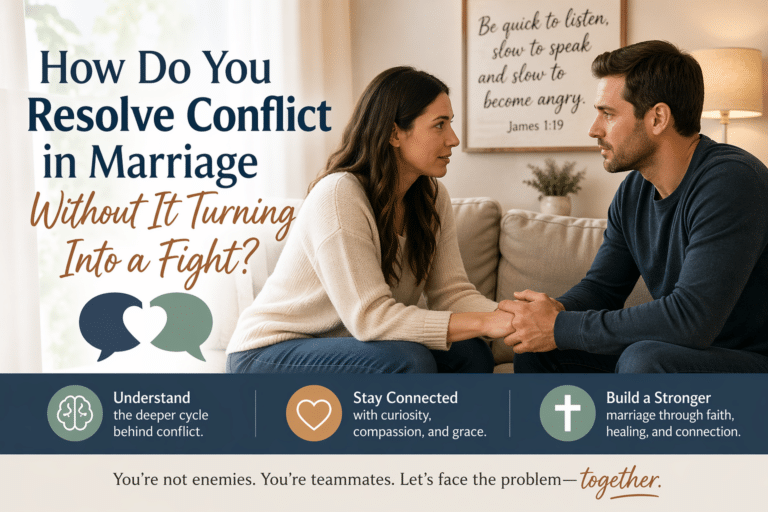
Why Marriage Can Feel So Big So Fast
You’re having what should be a small disagreement.
Maybe your spouse forgot to text. Maybe they seemed distracted at dinner. Maybe they used that tone—you know, the one that makes your whole nervous system stand up and shout, “Absolutely not, we’ve seen this movie before.”
Suddenly, your heart is racing. Your chest feels tight. Your mind starts building a case.
“They don’t care.”
“I’m not safe.”
“They’re going to leave.”
“I knew I couldn’t trust this.”
And before you know it, the conversation is no longer about the forgotten text, the tone, or the chore. It’s about something much deeper.
That’s how past trauma and insecurity often show up in marriage. We think we’re reacting only to our spouse in the present moment, but many of our most intense marital conflicts are actually echoes of old wounds playing out in real time.
From a Neuroscience Informed Christian Counseling® perspective, this makes sense. God designed your brain and body to protect you. When something feels familiar to a past hurt, your nervous system may respond as if the old danger is happening again—even if your spouse is not actually threatening you.
This doesn’t mean you’re broken. It means something in you is asking for healing.
And friend, healing is possible.
If conflict has become a painful pattern in your relationship, Christian marriage counseling can help you and your spouse understand what is happening beneath the surface and begin rebuilding safety together.
Trauma in Marriage Is Often About the Past Showing Up in the Present
Trauma is not just “something bad that happened.” It is what gets stuck in the nervous system when pain overwhelms our ability to process it.
In NICC language, we often talk about wounds, gaps, and immature habits:
Wounds are the painful things that should not have happened but did.
Gaps are the good, nurturing, protective things that should have happened but didn’t.
Immature habits are the survival strategies we learned to use when we didn’t have the safety, support, or maturity we needed.
Those strategies may have helped you survive earlier seasons of life. But in marriage, they can quietly become the very patterns that block the connection you’re longing for.
This is why your reaction may feel “too big” for the moment. Your spouse may be five minutes late, but your body may be remembering years of feeling forgotten. Your partner may ask for space, but your nervous system may hear abandonment. Your spouse may give gentle feedback, but an old shame wound may translate it into, “I’m never enough.”
That’s not you being dramatic. That’s your nervous system trying to protect you with old information.
The good news is that old information can be updated. God designed the brain with the capacity to heal, grow, and form new patterns through safe, life-giving experiences.
How Past Trauma and Insecurity Show Up in Marriage
Past trauma rarely walks into marriage wearing a name tag that says, “Hi, I’m your unresolved pain.”
Wouldn’t that be convenient?
Instead, it usually shows up as reactions, assumptions, shutdowns, arguments, or emotional distance. Here are some of the most common ways it appears.
Hypervigilance and Suspicion
Hypervigilance means your nervous system is constantly scanning for danger.
In marriage, this can look like reading your spouse’s tone, facial expression, text response time, body language, or mood as possible evidence of rejection or betrayal.
You may find yourself thinking:
“Are they mad at me?”
“Why did they say it like that?”
“They seem distant. Something must be wrong.”
“I need to figure out what they’re really feeling before I get hurt.”
Hypervigilance often develops when safety was unpredictable in the past. If you grew up around criticism, abandonment, emotional volatility, betrayal, or neglect, your brain may have learned to watch closely because watching helped you survive.
But in marriage, constant scanning can exhaust both partners. The spouse who feels unsafe becomes anxious and reactive. The spouse being scanned may feel accused, misunderstood, or like they can never get it right.
Nobody wins. The alarm system is too loud for love to feel safe.
Disproportionate Reactions
Sometimes a small marital moment triggers a huge emotional response.
Your spouse forgets to call, and you feel panic.
They interrupt you, and anger floods your body.
They need time alone, and despair takes over.
They offer feedback, and shame swallows you whole.
In the present, the issue may be small. But your body is not reacting only to the present. It may be reacting to every previous moment that felt similar.
This is what happens when the brain’s threat detector—the amygdala—sounds the alarm. When it perceives danger, your body can move into survival mode: fight, flight, freeze, or fawn.
Fight may look like attacking, criticizing, or escalating.
Flight may look like leaving the room, avoiding the conversation, or staying busy.
Freeze may look like going blank, shutting down, or feeling unable to speak.
Fawn may look like appeasing, apologizing too quickly, or abandoning your own needs to keep the peace.
These responses are not random. They are protective. But when they take over, it becomes hard to stay emotionally present with your spouse.
For couples who feel stuck in repeating arguments, learning how to resolve conflict in marriage without escalating can be an important first step.
Emotional Withdrawal or Numbness
Not every trauma response is loud. Some are very quiet.
One spouse may shut down during conflict. Another may avoid deeper conversations. Someone may stop initiating affection, stop sharing feelings, or retreat into work, parenting, screens, chores, or ministry.
From the outside, withdrawal can look like indifference.
But underneath, it may be self-protection.
For some people, vulnerability has not felt safe. Maybe opening up led to criticism. Maybe needs were dismissed. Maybe closeness was followed by pain. So the nervous system learned, “Don’t need too much. Don’t feel too much. Don’t let anyone get too close.”
That strategy may reduce immediate risk, but it also blocks intimacy. Marriage cannot thrive when one or both partners are emotionally armored all the time.
Fear of Abandonment
Fear of abandonment often shows up as a constant need for reassurance.
You may ask, “Are we okay?” over and over.
You may feel panicked when your spouse needs space.
You may interpret tiredness, distraction, or quietness as rejection.
You may cling, pursue, protest, or become angry when connection feels uncertain.
This often comes from a wound in the domain of Connection—our God-given capacity to trust, bond, reach for comfort, and receive love.
If connection was inconsistent or painful earlier in life, marriage can activate deep fears. The longing is good: “I want to be close to you.” But the fear can make closeness feel desperate instead of secure.
Negative Self-Perception
Insecurity often whispers cruel things.
“You’re too much.”
“You’re not enough.”
“They’ll leave when they really know you.”
“You don’t deserve love.”
“Their affection can’t be genuine.”
When shame is active, it is hard to receive love, even from a faithful spouse. You may test your partner, push them away, doubt their motives, or brace for rejection.
This is one of the sneakiest ways insecurity damages marriage. It doesn’t just make you feel bad about yourself. It makes your spouse’s love feel unbelievable.
That is heartbreaking. And also healable.
Why Your Nervous System Reacts Before Your Logic Does
One of the most compassionate things we can understand about marriage conflict is this:
Your body often reacts before your thinking brain catches up.
When your nervous system senses danger, it does not pause to ask, “Excuse me, is this a present-day issue, or are we dealing with a historic wound from 2007?”
Nope. The alarm just goes off.
In NICC, we understand anxiety and trauma responses as signals from the body and soul. They are not proof that you are weak, unspiritual, or failing as a spouse. They are signs that something inside needs care, regulation, and healing.
This is where Christian counseling can be so helpful. A trained therapist can help you slow down, notice what is happening in your body, name the emotional pattern, and identify the old wound or unmet need underneath the reaction.
That kind of work helps couples move from accusation to understanding.
Instead of:
“You always overreact.”
You begin to say:
“When that happened, something old got touched in me.”
Instead of:
“You don’t care about me.”
You begin to say:
“I’m feeling scared and disconnected. Can we slow down and find each other?”
That shift matters. It turns the marriage from a courtroom into a healing space.
Moving From “You vs. Me” to “Us vs. the Wound”
When trauma enters the room, couples often end up fighting each other instead of fighting for healing.
One spouse feels accused.
The other feels abandoned.
One pursues.
The other withdraws.
One raises their voice.
The other shuts down.
Pretty soon, both people are hurt, defensive, and convinced they are the only one trying.
But healing begins when the couple learns to say, “This pattern is the problem—not you. Not me. The wound. The fear. The survival response. That is what we are working on together.”
Try language like:
“I’m feeling triggered, and I think this is connected to something older.”
“My reaction feels bigger than this moment. Can we slow down?”
“I don’t want to fight you. I want us to understand what is happening.”
“I need reassurance, but I want to ask for it in a healthy way.”
“I’m shutting down. I’m not leaving you—I’m overwhelmed.”
This kind of language does not excuse hurtful behavior. It helps both partners take responsibility with compassion.
That is a very Christian move, by the way: truth and grace holding hands.
What to Do When Trauma Gets Triggered in Marriage
Healing trauma in marriage is not about pretending the past does not matter. It is about learning how to respond when the past gets activated.
Here are practical, faith-centered steps to begin.
1. Name the Trigger Without Blaming Your Spouse
Awareness is the first step.
Start noticing when your reaction feels larger than the current situation. Pay attention to your body:
Racing heart
Tight chest
Knotted stomach
Heat in your face
Frozen thoughts
Urgency to fix, flee, attack, or appease
Then gently ask:
“What did this moment feel like?”
“What story did my body tell me?”
“When have I felt this before?”
“What was I afraid would happen?”
You might discover that the present moment touched an old wound. Once you can name that, you can begin separating your spouse’s current action from the pain your body is remembering.
2. Practice Grounding Before Continuing the Conversation
When your nervous system is in survival mode, it is usually not the best time to solve a marriage issue.
That is not a character flaw. That is biology.
Before continuing, try grounding your body in the present moment.
Use the 5-4-3-2-1 technique:
Name 5 things you see.
Name 4 things you can touch.
Name 3 things you hear.
Name 2 things you smell.
Name 1 thing you taste.
Or try slow breathing:
Breathe in for 3 counts.
Exhale for 5 counts.
Repeat until your body begins to settle.
Longer exhales help communicate safety to the nervous system. It is a simple way to tell your body, “We are not back there. We are here. We are safe enough to slow down.”
3. Create Predictable Safety
Trauma survivors often need consistency before they can relax into trust.
In marriage, predictable safety is built through small, repeated experiences:
Following through on commitments
Being honest, even when it is uncomfortable
Repairing quickly after conflict
Respecting boundaries
Using a calmer tone
Checking in regularly
Keeping affection pressure-free
Making space for both partners’ feelings
These may seem small, but small things done consistently become the bricks of trust.
For couples healing from betrayal or broken trust, rebuilding trust in marriage often requires both emotional repair and practical consistency.
4. Build Rituals of Connection
Couples do not drift into safety. They practice it.
A daily five-minute check-in can be powerful. Keep it simple:
“How are you feeling today?”
“Is there anything between us we need to clear up?”
“What kind of support would feel good right now?”
“How can I pray for you today?”
This is not the time for a three-hour State of the Union address. Save that for another day, preferably with snacks.
The goal is simple connection. Little moments of attunement help your nervous systems remember, “We are on the same team.”
5. Honor Boundaries and Consent
Trauma can make physical touch, emotional intensity, or conflict feel unsafe.
Healthy couples talk openly about boundaries. They do not assume.
Ask:
“Would a hug feel comforting right now or overwhelming?”
“Do you want advice, or do you just need me to listen?”
“Is now a good time to talk, or should we come back to this after dinner?”
“Do you need closeness or space?”
Consent is not cold or unromantic. It is one way love becomes safe.
Especially when trauma has affected intimacy, consent and clear communication help rebuild trust in the body—not just in the mind.
6. Invite Jesus Into the Real Story
Christian healing is not about bypassing pain with spiritual language.
It is not, “Just pray harder and stop feeling that.”
It is bringing the real wound into the presence of the real Jesus.
Scripture tells us the Lord is near to the brokenhearted. That means we do not have to clean up our emotions before coming to Him. We can invite Him into the fear, the shame, the anger, the grief, and the longing.
A simple prayer might be:
“Jesus, this feels bigger than the moment. Help me understand what is happening in me. Help us find safety, truth, and love together.”
That prayer may not instantly fix the conflict. But it can help shift your posture from panic to presence.
When You Need More Than Communication Tips
Communication skills are helpful. Truly.
But when trauma and insecurity are driving the conflict, skills alone may not be enough. You can learn all the “I statements” in the world and still feel hijacked when your nervous system believes you are unsafe.
That is why NICC does not focus only on behavior. It integrates biblical wisdom with neuroscience-informed care to address the brain, body, emotions, relationships, and spirit together.
In other words, we are not just asking, “How do we stop fighting?”
We are asking deeper questions:
What wound is being touched?
What need went unmet?
What survival strategy is taking over?
What life-giving experience does this person need now?
How can this couple experience safety, truth, and connection in Christ?
For some couples, especially when trauma, anxiety, depression, betrayal, or attachment wounds are involved, Christian counseling for anxiety, depression, and trauma can provide the support needed to heal what is beneath the pattern.
A Simple Path Forward
If your marriage has been shaped by past trauma or insecurity, you do not have to figure it out alone. And you do not have to wait until things are falling apart to get help.
A healing path may look like this:
Connect
You and your spouse connect with a counselor who understands both your faith and your nervous system.
Clarify
Together, you begin identifying the patterns beneath the conflict: triggers, wounds, fears, attachment needs, and survival responses.
Change
Over time, with safe, guided support, you learn new ways to regulate, communicate, repair, and reconnect. Your nervous system begins to experience your spouse not as the enemy, but as a partner in healing.
That does not mean every marriage heals quickly or easily. Trauma work takes courage, patience, honesty, and grace.
But many couples discover that the conflict they feared was the end of their marriage becomes the doorway into deeper healing.
Conclusion
Past trauma and insecurity can make marriage feel confusing, painful, and exhausting. One moment you’re talking about dishes, schedules, or tone of voice. The next, you’re both caught in a storm that feels much bigger than the present moment.
But that storm is not the whole story.
Your reactions make sense. Your spouse’s reactions likely make sense too. And with the right support, those old survival patterns can become invitations to healing rather than barriers to intimacy.
You can learn to slow down.
You can learn to name what is happening.
You can build safety one small moment at a time.
You can stop fighting each other and start healing together.
If this article feels close to home, connecting with a therapist through MyCounselor.Online may be a wise next step. Christian marriage counseling can help you and your spouse understand the deeper story beneath your conflict and begin rebuilding connection with faith, compassion, and hope.
You’re not crazy. You’re not hopeless. And your marriage is not beyond the reach of Jesus’ healing work.
We’re cheering you on.